A First Walk Around the Garden After Leaf Fall
A first walk around the garden after leaf fall helps you compare the same views across seasons and decide which changes merit attention before spring.
Which parts of your garden still make sense after the leaves fall? A first walk around the garden after leaf fall lets you compare the space with its leafy-season version, rather than treating winter as a separate design problem. The useful record is not a catalogue of bare spots; it is a set of observations about what changes, what stays legible and what deserves another look.
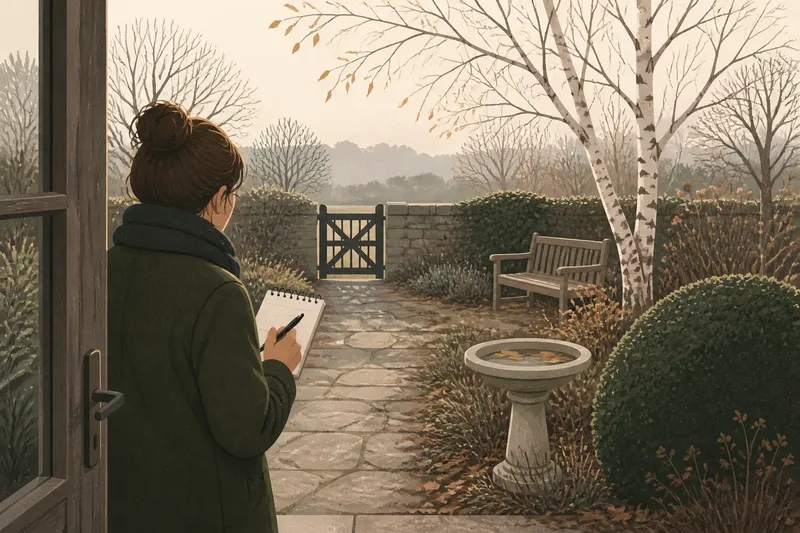
Say Mara has a small town garden with a birch, a clipped evergreen mound, a stone birdbath and a bench facing the far corner. She takes a photograph from the kitchen door in leafy weather, then walks the same route after leaf fall and takes another from the same doorway. The birdbath is easier to see, the birch no longer screens the distant gate, and the bench’s view feels less sheltered. She records these differences before deciding whether any of them call for action.
Compare the same places across the seasons
Start from a few places you use often: a kitchen door, a terrace, a path entrance or a bench. Keep the viewpoints consistent between visits. A photograph can help, but a note naming the standing place and the feature in view is often enough.
At each stopping point, record what has changed since the garden was leafy. Note whether a feature has appeared, disappeared, become more prominent or simply changed its relationship to something nearby. A winter view is like a room seen with its curtains open: it reveals what was already there, but not necessarily what you want to keep exposed.
For Mara, the comparison shows that the birdbath was present all along, but foliage softened its outline. The gate, by contrast, was hidden in summer and now pulls her eye beyond the garden. These are seasonal changes in emphasis, not automatic instructions to add or remove anything.
Record seasonal changes before judging them
Use brief, neutral notes. “Gate visible from bench after leaf fall” is more useful than “bench view is wrong”, because the first describes an observation without deciding what it means. Add the date or season and the viewpoint so you can compare the note with a later visit.
Separate what you see from what you think it means. You might notice a boundary that has become more prominent, a path edge that is now easier to follow, or a familiar plant whose outline has changed. The point is to learn which features are reliably present and which depend on foliage, light or the observer’s position.
In Mara’s notes, the birdbath is “visible from kitchen door after leaf fall, partly screened in summer”. She leaves the question of whether it should be a focal point unanswered. That small restraint saves her from turning every seasonal reveal into a garden project.
Use a repeatable record to guide later decisions
A compact observation list can keep the walk useful without making it a survey. For every entry, state what you see and what you will do if that observation persists or proves seasonal.
- Check whether the same feature is visible from the same doorway in both seasons; if its visibility changes but causes no practical concern, keep the note, otherwise compare another familiar viewpoint before considering a change.
- Check whether a newly exposed boundary draws your attention during ordinary use; if it does, record which viewpoint is affected, otherwise leave it as a seasonal observation.
- Check whether a path edge is easier or harder to follow without foliage; if the route remains clear, make no change, otherwise note the precise section to review.
- Check whether a plant’s outline changes the view from a place you use; if the effect is welcome, retain the observation for comparison, otherwise check the plant’s care needs before considering pruning or relocation.
- Check whether an object such as a birdbath becomes easier to see after leaf fall; if that suits its purpose, leave it in place, otherwise compare its visibility from another regularly used viewpoint.
- Check whether the distant view is more prominent in winter; if it adds depth, record that effect, otherwise note where it distracts and revisit the view in another season before deciding what to do.
For Mara, the resulting decision is specific: she does not move the birdbath or prune the birch after one walk. She keeps the paired photographs and notes, then plans to compare the bench view when the garden is leafy again. The observable result she is seeking is a clearer answer about whether the gate distracts her throughout the year or only after leaf fall.
What should you record on a seasonal garden walk?
Are photographs useful for comparing seasons?
Yes, if you take them from repeatable places. Include a recognisable landmark, such as a door frame or bench, so you can tell whether the viewpoint has shifted.
Should you prune a plant because its winter outline looks untidy?
Do not decide from appearance alone. Check the plant’s care requirements and consider its other seasonal value before pruning; ask a qualified local professional if plant health or wildlife concerns make the decision unclear.
How many viewpoints should you compare?
Choose the places you regularly use, rather than trying to document every corner. A small, consistent set is easier to revisit and makes seasonal changes clearer.
What if a seasonal change seems to need attention?
Write down the feature, the viewpoint and the season before choosing an action. If the issue affects access, safety or a boundary, seek qualified local advice where appropriate.
Let seasonal observations mature before acting
After leaf fall, Mara has a record of the birdbath’s visibility, the newly exposed gate and the bench’s altered outlook. She leaves the garden unchanged and checks those same views again in leafy weather. If the gate then disappears and the bench feels sheltered, she has learned that the concern was seasonal; if it remains distracting, she has a clearer basis for considering a proportionate change.
A first walk around the garden after leaf fall works best as one entry in an ongoing record, not as an annual verdict. Keep observations tied to familiar viewpoints, note what changes with the season, and make decisions only when the pattern is clear enough to matter.