The Conservatory’s Changing Role from Plant House to Garden Room
The changing role of the conservatory traces its shift from sheltered plant house to domestic garden room, clarifying how both purposes came to coexist.
When did the conservatory stop being chiefly a place for plants and become a room for people as well? The changing role of the conservatory was not a clean handover: plant keeping and domestic use overlapped, and their balance varied between buildings and households.
The term has been used for structures with different designs and purposes, so a single origin story would be misleading. Broadly, conservatories belong to the history of glasshouses and domestic garden architecture; their social role is best understood as an addition to plant display, not a universal replacement for it.
Conservatories joined plant keeping to domestic display
Glass offered a way to shelter plants that could not readily withstand outdoor conditions, while also making them visible. In a domestic setting, a conservatory could therefore serve practical horticulture and display at once. Benches, pots and orderly access suited care; the glazed enclosure turned the collection into something to be viewed.
That combination matters to the history. A room containing plants was not necessarily a purely working glasshouse, and the presence of seating did not mean that plants had ceased to matter. The distinction between a place for cultivation and a place for company could be blurred from the outset.
Domestic use developed alongside horticultural purpose
As conservatories became part of the designed relationship between house and garden, they could also provide a sheltered place to sit or receive visitors. This account is deliberately broad: the pace and form of change depended on the building, its owners and the plants it housed, rather than following one uniform historical sequence.
A conservatory could keep tender plants while making room for chairs and conversation. In that arrangement, horticulture remained visible and active, but the room also became a setting for domestic life. The shift was less a conversion than an accumulation of uses.
Architecture made the overlap visible
Glazing brought the garden into view, while the connection to the house made the conservatory usable as an extension of domestic space. Its position could make it a threshold between indoors and outdoors as well as a shelter for plants. Those functions were compatible, though they did not always receive equal attention.
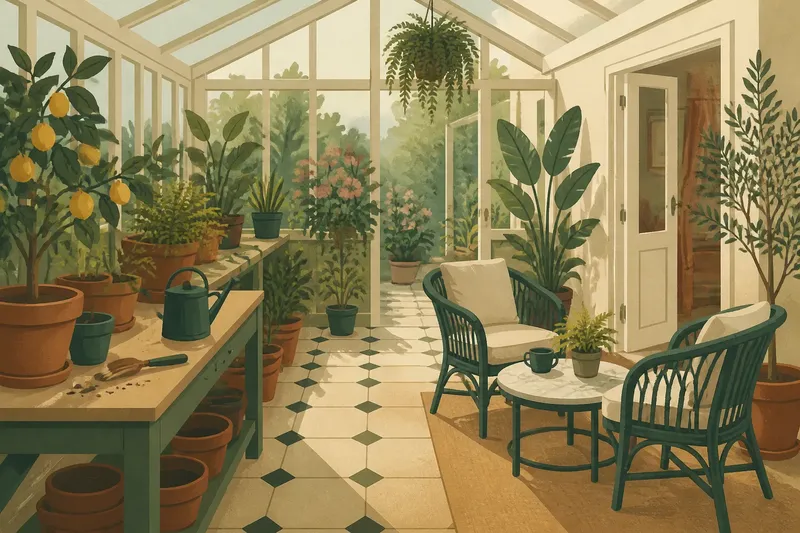
Plant benches and access for tending indicate a room organised around cultivation. Chairs and a clear place to gather suggest that sitting had become a meaningful use, even if plants remained central. Like a table used for both meals and mending, the room could accommodate different activities, provided neither made the other impossible.
Different conservatories kept different priorities
Some conservatories remained chiefly devoted to plant collections, with benches and working space taking precedence. Others were arranged more like garden rooms, where plants framed views and made the setting feel connected to the outdoors. Between them sat rooms in which plant care and social use shared space without a firm boundary.
Imagine a household with a glazed room already used to shelter citrus in cold weather. Its occupants add a pair of chairs but keep the plants on accessible benches; the observable result is a room where sitting becomes possible while tending remains part of its routine. This invented example illustrates coexistence, not a claim about a particular historical household.
What changed in the conservatory’s role?
Was a conservatory originally only for plants?
Not necessarily. The broad historical association is with sheltering and displaying plants, but domestic buildings and uses differed, so “only” is too absolute. Seating and company could coexist with horticultural work.
Did garden-room use replace plant growing?
No single transition applies to every conservatory. Social and domestic uses could develop alongside plant keeping, while some rooms retained a strong horticultural purpose.
Why did conservatories suit both plants and people?
Glazing made plants visible and created a sheltered interior connected to the garden. That combination could support display and cultivation while offering a place to sit, depending on how the room was arranged and used.
What does the changing role of the conservatory mean?
It describes a gradual widening of purpose rather than a simple change from glasshouse to sitting room. Conservatories could be horticultural spaces, domestic rooms or a mixture, with the balance shaped by their particular history.
Use the room’s details to read its history
When considering a conservatory’s past, look at how its features relate to one another. Benches, working access and plant displays point towards cultivation; seating and a connection to the house suggest domestic use. Neither clue settles the matter alone, but together they help explain how the room’s purposes may have overlapped.
The changing role of the conservatory is therefore best understood as a history of accommodation: glasshouse functions persisted while domestic life found a place among them. A room’s most useful clue may be the route between its plants and its chairs, because that route shows whether the two were expected to share the day.