Why a Garden Path Changes What You Notice
See how a garden path directs attention, and adjust its line, edges and turns to make views feel clearer without changing the planting.
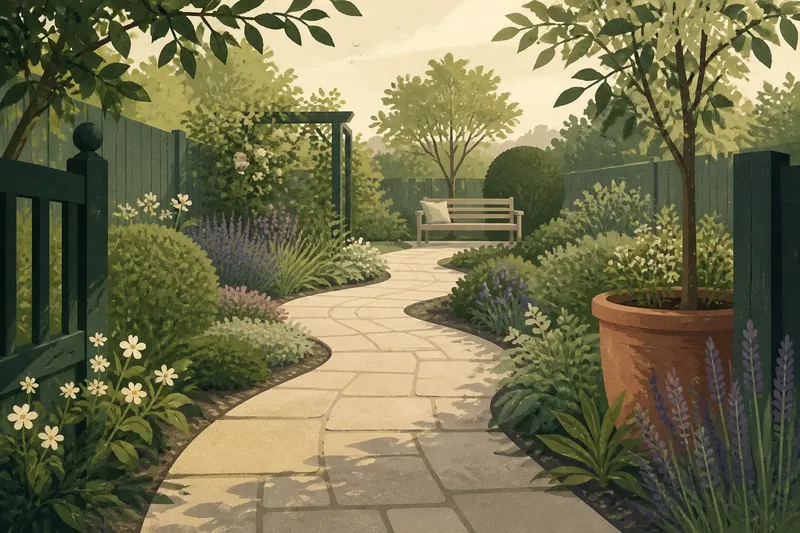
Why does a garden path change what you notice? A garden path directs attention before you have consciously chosen where to look: its line suggests a destination, its edges frame nearby plants, and each turn decides when the next view appears. If the garden feels oddly flat, crowded or confusing, the path may be doing more visual work than it seems.
A straight path makes the whole garden arrive at once
A straight route gives the eye an uninterrupted run towards whatever lies at its end. That can be useful when the destination deserves attention, such as a gate, bench or small tree. It is less helpful when the endpoint is a bin store, a blank fence or an accidental gap between shrubs.
The usual cause is not straightness itself but an unconsidered view down the line. Stand at the entrance and follow the path with your eyes. If the route ends on something visually dull, try shifting the apparent destination with a container, a trellis panel or a change in paving that gives the eye a more deliberate stopping place. Keep the feature in scale with the garden; a modest endpoint often reads more convincingly than an object recruited to perform as a monument.
If there is no suitable feature to draw attention, a slight change in direction can interrupt the long view. This need not mean laying a decorative curve for its own sake. A small, purposeful kink can make a side border or a garden room appear gradually, while retaining a clear route for walking.
A winding path can hide the useful parts
A curve can create anticipation, but too many bends can make a compact garden feel like a puzzle with unnecessary clues. The eye follows the route rather than settling on its surroundings, and a useful view may remain concealed behind an edge of planting or a fence.
Look for places where the path changes direction without revealing anything new. The likely cause is a bend that has no compositional job: it neither protects a view nor directs attention towards a destination. Consider easing that bend or opening the view beside it, perhaps by lowering a screen of low planting or moving a pot that blocks the sightline.
Imagine a narrow garden where a path makes two turns before reaching a small seating area. If the first turn already reveals the seat, the second may only delay arrival. Straightening that later section could make the seat easier to find while preserving the first turn’s sense of discovery. The expected visible result is a clearer view and a route that still unfolds in stages.
Hard edges can make a border look smaller
A crisp edge gives a path definition, but a strong line on both sides can make a garden feel like a corridor. This is especially noticeable when the paving is broad, the borders are narrow, or the same material continues without interruption towards a wall.
The cause is often the combined weight of the edges, rather than any single material. Brick edging, metal strips, timber boards and tightly clipped borders each make a visible line. When several run parallel, the eye reads them as rails. Soften one side rather than removing every boundary: let a low planting edge meet the paving in places, vary the line of a border, or use a restrained change in surface to distinguish a threshold.
Think of a path edge as the rim of a plate. A fine rim can organise what sits inside it; a heavy one can become the first thing you see. Choose a boundary that suits the path’s role and the surrounding materials, not merely one that is easy to keep straight.
Turns can reveal a view too early or too late
A turn controls when a visitor sees what lies ahead. If a focal point appears immediately, it may lose its sense of arrival. If it stays hidden until the last moment, the route can feel abrupt or make the destination hard to locate.
Check the view from three positions: the path’s entrance, just before the turn and just after it. The cause of a weak sequence is often a screen that blocks too much or too little. Adjust the opening rather than adding more objects: a gap between shrubs, a lower panel in a fence, or a change in the path’s angle can reveal part of the destination first and the rest on approach.
A turning point should also feel physically legible. A sudden corner beside a dense hedge can look like the route ends. A subtle widening, a paving change or a visible continuation beyond the bend can make the direction clear without resorting to a sign.
Why does the path keep pulling your eye away?
Why does a pale path dominate the garden?
A light surface can stand out against darker soil, foliage or fencing, so the eye may follow the paving before it notices the garden around it. If the route feels too prominent, introduce a quieter transition at the edge or choose a finish that sits more comfortably with nearby materials.
Why does the path seem narrower than it is?
Strong, continuous edging can make the usable surface appear pinched, even when walking is comfortable. Check whether the border plants, raised edging or adjacent walls create a second visible boundary, then soften the less important line where practical.
Why does a path feel aimless?
A route can lack direction when it has no visible destination, no clear turn and no change in view. Give the eye one reason to continue, such as a framed opening or a visible seating place, rather than adding decorative features at every interval.
Why does a path make a small garden feel divided?
A broad route or strong edge can split the space into separate strips. If the path is not meant to be the main feature, reduce its visual contrast or let a border cross its line in one carefully chosen place, keeping the walking route clear.
Use the path’s line to organise the view
Before changing paving, walk the route slowly and note where your gaze goes without effort. Look for the first thing you see, the point where the view changes, and the place your eyes settle at the end. These observations identify whether the problem lies in direction, edge or timing.
Then make one adjustment and look again from the same positions. Moving a pot, opening a sightline or changing a small section of edging is easier to assess than altering several features at once. If the path is being rebuilt, check the suitability of materials and any relevant access requirements against the manufacturer’s guidance and local rules.
A garden path is not only a way across the ground. Its direction, edges and turns edit the view as you move, much as a picture frame selects what sits within it. When a garden feels difficult to read, consider the path’s visual instructions before replacing plants; the most useful change may be to let the eye arrive somewhere better.