The Bare Patch Is Not Always a Design Failure
Bare patches in garden design can clarify a border’s layout. Learn how to judge their position, surface and upkeep before deciding to plant them.
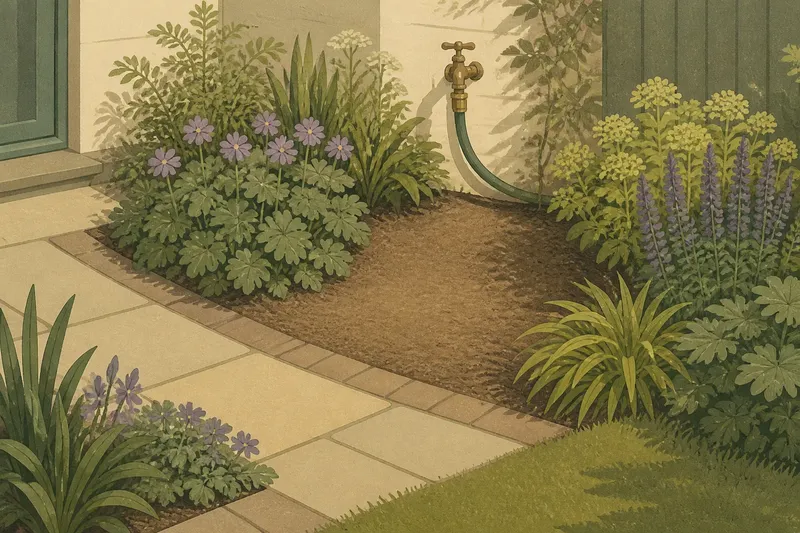
Does that empty patch need another plant? Bare patches in garden design can be useful when they organise a bed, mark a transition or leave room for access. The question is whether the gap serves the layout, rather than whether it makes individual plants stand out.
Bare patches in garden design need a clear role
Start with the job the patch is doing. It might separate a planted bed from paving, preserve access to a tap, provide room to reach a fence, or connect two areas of gravel. These are layout decisions: they affect how people move through and use the garden.
A gap looks accidental when its edges have no relationship to a path, boundary or practical task. A dead stem or scattered weeds can make that impression worse, but tidying alone will not fix a patch that interrupts the route through a bed or leaves an awkward sliver beside the lawn.
Inspect the area from the garden entrance and from the places where you sit or work. Then walk the route beside it. A patch that looks orderly from indoors may be too narrow to reach through comfortably, while an opening that seems large from the path may make sense as a clear working space near a gate.
Let paths and boundaries shape the opening
Existing lines provide useful clues. A bare area that follows a paving edge, the foot of a wall or the curve of a path is easier to read than an isolated patch with an arbitrary outline. The edge need not be formal, but it should relate to something else in the garden.
Check how the opening meets the lawn or paving. If loose soil spills onto a path, a clean cut with a spade or a suitable edging material can define the boundary. If the patch sits inside a planted bed, repeated straight borders may look forced; a simple curve that follows the bed’s existing shape may work better.
Think of the boundary like the rim of a tray: it keeps separate materials from looking accidentally mixed. The analogy has limits, but the useful point is that an edge should contain the surface without drawing more attention than the garden itself.
Decide whether the space is for access or appearance
An access gap should be judged by what must pass through it. Leave room to reach a hose tap, open a gate or inspect a fence without trampling plants. If the opening is purely visual, it can be smaller and placed where it balances the bed’s larger areas.
Say you have an invented, hypothetical courtyard border with a hose tap behind a clump of hardy geraniums and a strip of paving along the front. First, identify the route needed to reach the tap, then remove only plants that block that route and tidy the exposed edge. From the doorway, check whether the remaining opening still connects visually to the paving; if it does, keep it as an access gap, and if it reads as a stray hole, reshape its edge or use a suitable surface to link it to the path. The trade-off is clear: a wider route is easier to use, but removes more planting area.
Choose a surface that belongs in the layout
Visible soil is one option, not the only one. Mulch can make an opening blend into a planted bed; gravel can connect it to a nearby path or seating area; paving may suit a place that needs regular access. A low groundcover can close the gap visually, but may make reaching a boundary or fitting through the space harder.
Before adding material, check drainage, nearby plant needs and the product guidance. Keep mulch away from stems and trunks, and avoid placing gravel where it would make a route awkward or uncomfortable to use. The right choice is the one that supports the patch’s purpose, not the one that merely disguises it.
Check the patch before changing it
- Check whether the patch lies on a route to a tap, gate or fence; if access is needed, keep a clear route, otherwise treat it as an ornamental opening.
- Check whether its edge follows paving, lawn or a bed boundary; if it does, retain that line, otherwise reshape the edge to relate to a nearby feature.
- Check whether soil or loose material spills onto the path; if it does, define the boundary with a clean cut or suitable edging, otherwise leave the existing edge undisturbed.
- Check whether the patch collects water or stays persistently damp; if it does, review drainage and surface choice before covering it, otherwise choose a finish suited to the planting and setting.
- Check whether nearby plants need the exposed area to remain open; if they do, avoid adding a surface or plant that crowds them, otherwise consider mulch, gravel or a suitable groundcover.
- Check whether weeds repeatedly establish in the opening; if they do, reduce the area or choose a manageable surface treatment, otherwise keep the gap and remove occasional weeds as part of routine care.
What do gardeners ask about bare patches?
Will a bare patch make a small garden look larger?
It may make a crowded layout feel calmer if it opens a route or separates the bed from a boundary. A patch placed without regard to paths and edges can instead look like lost planting space.
Should I use mulch or gravel?
Mulch usually blends more quietly into a planted bed, while gravel can connect an opening to an existing gravel path or seating area. Check the plants’ needs and the site conditions before choosing either surface.
Can I leave the space where a plant has died?
Yes, if the gap now serves a useful route or has a clear relationship to the bed’s boundaries. Remove dead material, then decide whether to keep the space open, cover it or replant after checking its light and drainage.
How do I know whether the opening is too large?
Check whether it interrupts the bed’s edge or takes up space needed for planting and access. If it does, reduce or reshape it; if it connects a route or boundary cleanly, its size may be appropriate.
Replant when the layout no longer works
Replant if the gap obstructs a route, clashes with the bed’s boundaries or leaves too little room for the garden’s intended use. Before selecting a plant, check light, drainage and available space so the replacement suits the position rather than simply hiding the soil.
If the opening serves access, keep that function visible and avoid planting it shut. If it has no practical role and remains disconnected from paths, paving or boundaries, a suitable plant or groundcover may make the layout more coherent. Bare patches in garden design are easiest to judge when you begin with the route and edges, then decide whether planting belongs there at all.